
04 Aug The Data Center Backlash: Public Opinion Has Collapsed
The backlash is growing and has real consequences
In the first three months of 2026, local opposition contributed to blocking or delaying proposed data centers representing roughly $130 billion in potential investment, according to Data Center Watch, a private research project that tracks the issue. The figure measures the announced value of stalled projects, not realized losses, and some of that investment may still occur later or elsewhere. The number is striking: it roughly matches what the same tracker recorded for all of 2025. Local opposition is blocking and delaying ever-larger amounts of investment, and the pace is accelerating.
By early August, Interconnected Capital’s national tracker counted 183 active local moratoriums or restrictions on data center development, across 43 states. Legislators in at least fifteen states have introduced state-level moratorium bills. In July, New York became the first state to impose a statewide moratorium, pausing new environmental permits for hyperscale data centers for up to a year. And the issue has begun deciding elections. In Maryland’s June 2026 primaries, the same issue produced electoral defeats in both parties in the same month: a Democratic council president in Frederick County and three Republican commissioners in Calvert County. These races were largely fought over data center decisions.
Public polling shows that opposition has hardened. The industry’s communication strategy plainly is not working. And current research still has substantial gaps in explaining how attitudes moved, which messages might be persuasive, and which audiences are persuadable.
Opinion didn’t drift. It collapsed.
The strongest evidence of change comes from pollsters who have multiple trend data points over time. On data centers, about eight have informative trends. And every one found movement in the same direction towards opposition.
In August 2025, Embold Research, polling for the energy outlet Heatmap News, found that 44 percent of registered voters would support a data center near where they live and 42 percent would oppose one, a margin of plus 2. By May 2026, the same question drew 21 percent support and 71 percent opposition: a margin of minus 50. A 52-point reversal in nine months.
Change Research, a Democratic-aligned pollster, measured registered voters’ attitudes toward building data centers nationally. In March 2025, voters favored construction 65 to 14. By April 2026, they opposed it 53 to 36. That margin moved 68 points in thirteen months, an incredible movement in attitudes over that period of time.
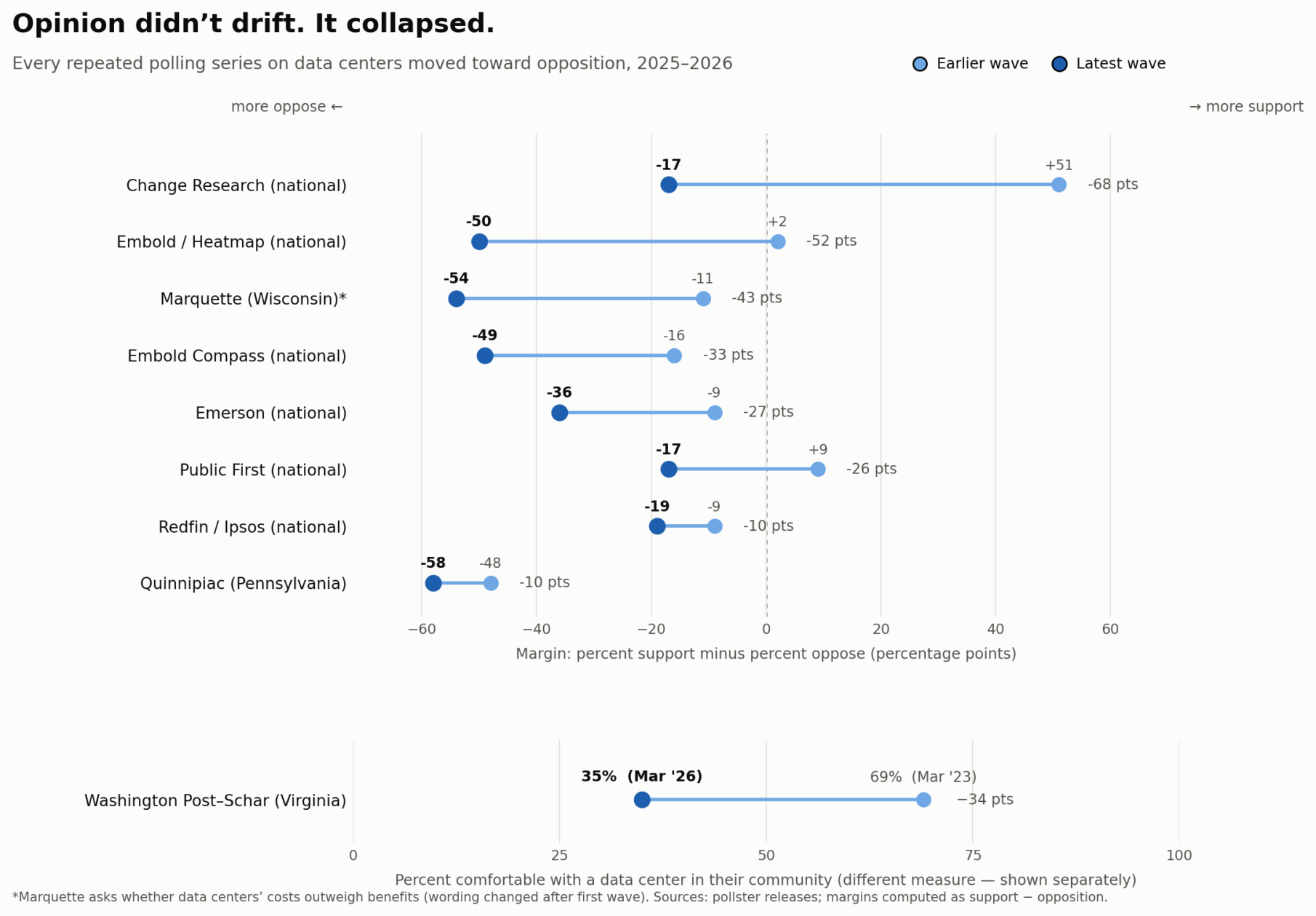
Share of Virginians comfortable with a data center in their community.
Other pollsters show a similar development, with slightly different timelines. The margin of opposition over support for data centers grew nearly everywhere: by 27 points in Emerson College’s national polling between December 2025 and July 2026, while the margin saying data centers’ costs outweigh their benefits widened by 43 points in Marquette’s Wisconsin polling. In a second Embold series, opposition’s lead grew 33 points between December and May, with strong opposition itself rising from 36 to 58 percent. Public First saw a 9-point lead for support in January become a 17-point lead for opposition by July, a 26-point swing. Even the slowest-moving series, Quinnipiac in Pennsylvania and a commercial series by Redfin and Ipsos, saw opposition’s lead widen by 10 points from already heavily unfavorable starting positions. And in Virginia, practically the industry’s home state, the Washington Post and George Mason University’s Schar School found the share of voters comfortable with a data center in their own community fell from 69 percent in 2023 to 35 percent in the spring of 2026.
These changes represent a dramatic collapse of opinion. Charles Franklin, director of Marquette Law School Poll, put it plainly: “The data centers backlash has been the fastest development in Wisconsin polling in my 15 years of the Marquette Law School poll.” Seb Wride, who leads polling at Public First, drew the same conclusion from his own data: “It’s rare to see political attitudes change this fast in an era where they are often quite static and partisan.”
When did the collapse in public opinion occur? The polls were not fielded often enough to name a single turning point, and some series had already turned unfavorable in 2025. The data suggest that the slide was underway through the fall of 2025, and between January and the spring of 2026 the bottom fell out. As late as mid-January, Public First still found slightly more support than opposition for a data center within three miles of home, which is the last net-favorable reading in any major independent series we located. By July 2026, the same question found opposition ahead by 17 points.
Where opinion stands now
Every major independent 2026 benchmark poll fielded since February finds opposition to data centers ahead of support, usually by wide margins.
| Pollster | Fielded | Population | Support | Oppose | Unsure/neutral/No Opinion | Margin (support − oppose) |
|---|---|---|---|---|---|---|
| Gallup | Mar 2026 | U.S. adults | 27 | 71 | 3% | −44 |
| Fox News | Jul 2026 | Registered voters | 30 | 70 | <1% | −40 |
| CBS News/YouGov | Jun 2026 | U.S. adults | 20 | 50 | 30% | −30 |
| Public Policy Institute of California | Jun–Jul 2026 | CA adults | 26 | 73 | 2% | −47 |
| Quinnipiac | Jul 2026 | PA registered voters | 16 | 74 | 10% | −58 |
| Harvard CAPS/Harris | Jul 2026 | Registered voters | 25 | 53 | 22% | −28 |
| Elon University | Mar 2026 | NC adults | 24 | 44 | 32% | −20 |
Selected 2026 benchmark polls. Margin equals support minus opposition; totals may not equal 100 because of rounding.
Across these selected polls, opposition ranges from 44 to 74 percent, and support from 16 to 30. Most find outright majorities opposed to data centers.
- Gallup found 71 percent of Americans opposed to an AI data center in their local area in their March 2026 poll.
- Fox News, polling registered voters in July 2026, found 70 percent opposed, with support falling below 50% even among MAGA Republicans.
- CBS News and YouGov in their June 2026 poll found 50 percent opposed, 20 percent in favor, and 30 percent unsure.
- The Public Policy Institute of California found 73 percent of Californians opposed. Quinnipiac found 74 percent in Pennsylvania.
- Harvard CAPS/Harris found opposition ahead 53 to 25, with 22 percent neither supporting nor opposing. In a question, 53 percent said a data center should not be allowed near them even if the company provided enough local jobs, benefits, and protections; 47 percent said it should be allowed under those conditions.
There are exceptions. Elon University’s North Carolina poll found opposition ahead of support, 44 to 24, but short of a majority, with 32 percent unsure. And Milltown Partners, a consultancy whose clients include AI companies, found a narrow 38-to-34 edge for support for building data centers near your home, the only net-favorable 2026 result we can find since February of this year.
The surveys that stay at or below 50 percent opposition are generally the ones that offer an explicit middle category (unsure, neither support nor oppose, or don’t know) option, which a quarter to a third of respondents take: 30% in the CBS poll, 32% in Elon’s, about 35% in Public First’s. Even amid hardening opposition, a meaningful share of the public remains undecided when given the chance to say so.
The middle hardened
A year ago, uncertainty dominated. In July 2025, Data for Progress found that 45 percent of voters had not heard enough about data centers to form a view, and more than 60 percent had heard nothing about construction in their own state. By January 2026, Pew Research Center (asking a differently worded question) found that three-quarters of Americans had heard at least a little about data centers. There still appears to be a portion of the population that remains uncertain or neutral, but where a pollster tracked it directly, the share who do not have an opinion contracted fast. Emerson’s neutral share fell from 25 percent in December to 10 percent in July, while opposition climbed from 42 to 63.
The movement is overwhelmingly one way. As uncertainty declined, opposition grew, and support either remained flat or declined. In none of the repeated siting or cost-benefit series we examined did support rise. And the opposition is not soft. In poll after poll that measured intensity, strong opposition alone now outnumbers all support for data centers combined. Gallup found 48 percent of Americans strongly opposed to a local AI data center, more than the 27 percent who strongly or somewhat support one. The same inversion appears in Embold’s national polling (55 percent strongly opposed against 21 percent total support), in California (44 and 26), in Texas (42 and 29), and in Maine (51 and 28). In Embold’s Compass series, strong opposition rose 22 points in five months.
The polls do not pinpoint a single cause for the collapse. But as awareness about data centers rose, opposition rose with it, and the undecided or neutral middle shrank. In Pew’s data, the people who had heard the most about data centers held the most negative views. Taken together, the public opinion strongly suggests the information people encountered during this period contributed to the hardening of opposition.
Republican majority support is gone, and Democratic opposition continues to grow
Democrats opposed data centers early, and their opposition in 2026 has deepened. In Embold’s polling, Democrats were already net-opposed in August 2025; by May 2026, 78 percent of Harris voters opposed a nearby data center. Public First found that opposition among Kamala Harris voters rose from 33 to 53 percent between January 2026 and July 2026. By spring 2026, Democratic opposition sat in the mid-seventies in many national surveys.
Republicans had supported the data center industry more consistently across early and mid-2025, but majority support is now gone. Embold measured Republican net support at plus 14 in August 2025. Change Research still found 56 percent of Republican-aligned voters favoring construction nationally in December 2025. By spring 2026, Gallup and Embold each measured Republican opposition at 63 percent. Roughly a third remain supportive, but the majority has flipped. In Embold’s series, Republican-aligned voters crossed from net support to majority opposition in under a year. Public First’s numbers agree in direction: Trump-voter opposition rose from 26 to 33 percent between January and July 2026. The University of Texas/Texas Politics Project poll is the exception: Texas Republicans still split about evenly (42% support vs 44% oppose in June 2026).
The numbers make plain that data center companies no longer have a dependable partisan base they can mobilize. Republican majority support is gone, and Democratic opposition continues to grow. The polling shows no partisan countermovement. When Republicans moved toward opposition, Democrats did not shift the other way, as can happen with partisan issues. Any effort to rebuild support may have to account for attitudinal differences from voters on each side of the partisan divide. There is no longer a single coalition to fall back on.
Electricity and water top the list of concerns
Pollsters have asked about people’s concerns toward data centers in a variety of ways. Some let people volunteer worries in their own words using open-ended questions. Some read a list and ask which worry matters most. Some ask whether a data center would be good or bad for specific reasons. The details shift with the format, but across formats, geographies, and party lines, two concerns repeatedly rise to the top: electricity and water.
When Gallup asked opponents to explain their opposition in their own words, half talked about resource use, with energy and water mentioned about equally, by 18 percent each. When Emerson asked Pennsylvanians to pick their top concern about data centers, they split among environmental impact (26 percent), taxpayer and utility costs (25 percent), and demand on the electric grid (25 percent). The two electricity-related answers together outdraw any other concern. When Embold tested eight arguments about data centers (four in favor, four against), the two most convincing arguments were the resource attacks: the argument that data centers’ electricity use drives up household utility bills scored a net plus 46 (the share finding it convincing exceeded the share finding it unconvincing by 46 points), and the water-use argument scored plus 34. The industry’s best-performing messages, that data centers “create high-paying construction and operations jobs” (plus 26) and expand the local tax base (plus 24) trailed both resource concerns. And Pew’s national ratings agree: environment and home energy costs were the two worst-rated of the five data center impacts it tested.
Electricity has become especially salient. In August 2025, Embold asked voters to rate a dozen possible causes of rising electricity prices, and 28 percent blamed data center construction “a lot.” That was near the bottom of the list of suspects. By May 2026, more than half blamed data center construction, making them the most-blamed cause of rising power bills. In Virginia, the Washington Post–Schar poll found 57 percent of voters saying data centers were having a negative impact on home energy bills.
There is another concern that may sit beneath tangible worries about electrical bills or water. When Harvard and MIT researchers modeled which beliefs actually predicted support for a local data center, expected effects on quality of life (noise, traffic, the feel of a place) predicted attitudes two to three times more strongly than expected effects on electricity prices. The same survey asked about four kinds of industrial facilities in their area: Americans rated a data center below an auto factory and a warehouse, above only a petrochemical plant. Quality of life is not what people volunteer as most important when asked directly. It accounted for about a fifth of opponents’ stated reasons in Gallup’s open-ended question, behind resource use. But the modeling suggests it may be what best organizes how people feel. If that is right, addressing electricity costs may be insufficient on its own. It answers the loudest complaint without touching the deepest one. That interpretation remains a hypothesis the existing evidence cannot confirm.
Why “jobs” may not be a sufficient message
The data center industry’s best argument is jobs, which shows some strength in the current polling. Pew found that jobs and local tax revenue were the only tested impacts of data centers that more Americans rate as more good than bad, with jobs drawing the largest positive share. When Gallup asked data center supporters to explain their support in their own words, two-thirds cited economic benefits. Jobs was the most common specific answer.
In July, the Rainey Center, a center-right research group, ran nine pro-data-center arguments against each other in head-to-head matchups: jobs against tax revenue, jobs against economic growth, and so on. Jobs won 65 percent of its matchups and was the only argument that carried every demographic and partisan group the study reported.
Current polling has not yet conducted a harder test. Rainey’s matchups pitted friendly arguments against each other. No published study we could find pits the jobs message against the opposition’s arguments. The closest evidence is Embold’s battery of questions, where both sides’ arguments were rated in the same survey and concern over utility bill increases outscored benefits from jobs by about 20 net points. This was a rating comparison, not a head-to-head persuasion test. And there currently isn’t any data on how the jobs message lands with opponents or the undecided, the people such a message would actually need to move. These gaps leave open a real possibility: the jobs message may win among friendly pro-data-center alternatives, but may not hold up against actual opposition. Messages that test well in isolation often need deep support to survive contact with real counter-arguments.
Current polling documents two weaknesses in the job message. First, voters read the jobs from data centers as temporary. CBS found about half expect data centers to boost jobs in the short term, while only 22 percent expect long-term gains and 42 percent expect long-term losses. Second, the promise is being made to a public that already expects the same industry to eliminate jobs. Quinnipiac found 70 percent of Americans believe AI will reduce the number of jobs. In Gallup’s open-ended follow-up, 12 percent of respondents who opposed a local AI data center cited AI replacing human workers without being prompted specifically about job losses.
The industry’s other favorite argument fares worse. When Embold tested the claim that data centers are “necessary for America to win the AI race against China,” it scored a net convincing rating of just 4 points, the weakest of the four pro-industry arguments tested and far behind jobs. Rainey’s July matchups found the same thing. Its two China arguments (the AI arms race with China, and storing family photos and passwords in data centers accessible to the Chinese government), finished near the bottom of the nine messages tested, winning 40 and 39 percent of their pairings. Jobs won 65 percent, and growth, water recycling, consumer prices, and taxes all finished ahead of both. The China arguments tested best among Republicans, and even there only 43 percent chose them in matchups.
New Carlisle, Indiana shows the limits of job benefits from data centers even when promises are kept. As of December 2025, Amazon’s data center campus there employed 935 full-time workers (about what they projected), at an average wage near $77,000, most of them Indiana residents. That same month, after a ten-hour hearing, the county council rejected a separate $13 billion data center proposed nearby. This is just one case, but it shows that even when data center builders meet projections and deliver jobs, it did not create acceptance for the next project.
Where does that leave the jobs message? The opposition’s strongest argument (utility bills) outscores it in the one survey that rated both. Its documented weaknesses, a benefit (jobs) perceived as temporary, promised by an industry associated with overall job elimination, are real. Its performance against actual opposition is untested. And, lying underneath it all, is the possibility that what ultimately organizes these attitudes may be a more fundamental reluctance to live near a large industrial facility.
Four likely contributors, and what the evidence can’t untangle
Why did opinion collapse? A change this large almost certainly has several contributing causes. The polling and the public record point to four contributors.
Bills rose, and data centers took the blame. Electricity prices climbed across much of the country during this period. The public increasingly connected those prices to data centers: in August 2025, 28 percent of voters told Embold that data center construction deserved “a lot” of the blame for rising electricity prices. By May 2026, more than half said so. Whether or not that connection is fair, a large share of the public drew that conclusion.
The information environment turned negative. Coverage of data centers grew enormously through 2025, and its tone worsened. PVcase, a solar-industry software firm, analyzed voices quoted in news coverage and public documents. They found the negative share of monthly coverage about data centers more than doubled during 2025, from 16 percent in January to 37 percent in December. The same analysis also found that industry sources supplied about half of all voices quoted in coverage and spoke overwhelmingly positively about data centers. But opinion collapsed anyway. Being quoted is not the same as being believed. Pew adds another data point: the more someone had heard about data centers, the more negative their views. Clearly, what the industry is saying and how they’re saying it isn’t working.
Anxiety about AI spilled over. Attitudes toward AI itself deteriorated across 2025 and 2026 as well. Quinnipiac found the share of Americans saying AI will do more harm than good rose from 44 percent in April 2025 to 55 percent in March 2026. They now find that 70 percent expect AI to reduce jobs. Prominent AI and business leaders fed that anxiety in widely covered statements through 2025: Anthropic’s Dario Amodei warned AI could bring a “white-collar bloodbath” and eliminate half of entry-level white-collar jobs. Amazon’s Andy Jassy told employees AI would shrink the company’s workforce, and Ford’s Jim Farley predicted AI would replace “literally half of all white-collar workers.” Attitudes about data centers and AI generally traveled together. Marquette found that among Wisconsin voters who think AI is developing too quickly, 79 percent believe that the costs of data centers outweigh the benefits, against 45 percent among those comfortable with AI’s pace. Whether the “AI” label itself drives opposition is unsettled. Echelon Insights ran a national test in June. Half its sample was asked about a data center described as supporting “digital services,” the other half about an “AI data center.” Support fell from 35 support vs 53 opposition, to 27 support vs 62 opposition (about 17 net points), when AI was named. Change Research’s similar national experiment in April found only a few points’ difference. But the evidence suggests data center association with AI is a drag on opinions. How big a drag is uncertain.
Secrecy and process failures repeatedly preceded backlash. The record of local data center fights repeats one sequence: secrecy, then a leak, then an explosion. Tucson’s city council voted 7–0 to reject a proposed annexation and development agreement for Project Blue after residents associated it with Amazon Web Services. And one of the industry’s largest players has, in effect, conceded the problem: amid mounting criticism of the nondisclosure agreements common across the industry, Microsoft pledged in March 2026 to stop using them with local governments worldwide, the first major tech company to do so (it will still use NDAs for land acquisitions). These are illustrations, but they suggest that industry secrecy and/or the perception of industry secrecy is undermining trust. When seven companies publicly pledged to cover their own energy costs, Consumer Reports found 75 percent of Americans doubted they would honor it. Escalent found that data center companies rank among the least-trusted voices in the entire debate. An industry this distrusted pays for every process failure twice: once in the fight it loses, and again in the doubt residents everywhere else attach to its promises.
The industry’s response isn’t visibly working
The observable record shows heavy industry spending before and during the period public opinion collapsed around late 2025 through the middle of 2026. Meta ran a $6.4 million television campaign across eight state-capital media markets and Washington, D.C. in late 2025, promoting jobs related to its data centers. An affiliate of the Data Center Coalition, the industry’s lobbying group, spent at least $700,000 on digital marketing in Virginia in fiscal 2024. A second affiliate spent $367,000 in North Carolina in a single month this summer. It’s unclear whether opinion would have fallen further without these campaigns. But polling clearly reveals that these efforts did not arrest the decline in public reception.
The industry’s advertising efforts have not overcome deep, pervasive distrust in the messenger. Escalent found data center companies credible to just 15 percent of residents across thirteen data center states. Data center companies were tied with the federal government for least trusted messenger in the data center debate. It’s possible that high-volume messaging from a distrusted source, on themes that bypass residents’ actual concerns, may be reinforcing the distrust towards the data center industry. But given the data, that’s just a hypothesis.
Even the industry’s most promising reassurances need more care than they are getting. In Embold’s split-sample test, specifying that a data center would generate a substantial portion of its electricity onsite from renewable sources raised the share of Democrats saying that would be more likely to support a data center project by 19 points, and lowered the corresponding Republican share by 16. The same reassurance moved the two parties in opposite directions.
What other infrastructure fights teach, and what they can’t
Research on compensation in contested infrastructure is mixed. Benefits can increase acceptance, but they can also backfire when residents interpret them as an attempt to buy consent, particularly when trust in the process is weak.1 In Sand Springs, Oklahoma, a volunteer fire department refused a $250,000 donation from Google over a data center construction project rather than jeopardize the public’s trust. Two recent community-benefit agreements further illustrate why their substance and development may matter. In Cedar Rapids, Iowa, the city approved an agreement in early 2025 placing up to $18 million in a city-controlled fund, paid annually by project phase. In Lancaster, Pennsylvania, a draft agreement providing up to $20 million in community contributions became public only two days before the council approved it in November 2025, and residents and community groups argued they had not been directly involved in the negotiations. The agreement did not settle the trust problem: months later, public debate over new data-center rules still centered on opposition, transparency, and the adequacy of the protections. The contrast suggests that benefits are more likely to be understood as fairness when the public has time, influence, and enforceable terms. They may read as a payoff when they arrive late.
The second lesson is about process itself. LBNL’s surveys of people who actually live near wind and solar projects found a repeated pattern: transparency from developers, early awareness, and a genuine chance to influence the outcome go together with acceptance. Neighbors of large solar projects reported receiving less engagement and information than they wanted; fewer than one in five had even been aware of the project before construction began. These are associations from other industries, but they offer potential lessons for the data center industry.
VCU’s July 2026 Commonwealth Poll found that 81 percent of Virginians support requiring data centers to pay additional fees to offset their electricity demand, including 69 percent of Republicans. Sixty-six percent of voters nationally back making community benefits agreements mandatory, according to the Rainey Center’s May 2026 national survey. Seventy percent of Pennsylvanians supported requiring data centers to bring their own energy, in Emerson’s November 2025 Pennsylvania poll. Those polls don’t necessarily show that meeting these conditions would turn opponents into supporters. The Harvard CAPS/Harris poll found that a majority opposed data centers even when jobs and benefits were stipulated. Protecting residents from added costs and imposing enforceable conditions appears to be the floor of any acceptance conversation, not the ceiling. There is broad demand for stronger terms, an expectation that data center companies will be held to requirements they do not set themselves.
What the next research should answer
Existing polling establishes where public opinion stands and how rapidly it has changed. The evidence above also points toward a practical research agenda that helps fill in existing gaps: determine which arguments survive opposition, who is a credible messenger, what groups of the general public remain open to persuasion, how communities judge proposed benefits, and how the information people encounter informs their attitudes.
The first priority should be realistic message testing. The jobs and economic-benefits case should not be tested only against other favorable arguments. It should be tested directly against the strongest concerns about electricity costs, water, quality of life, land use, and secrecy. Research should measure not only whether a message produces an initial movement, but whether that movement survives credible counterarguments.
Research should also identify supporters and opponents while examining the strength, structure, and limits of their attitudes. That means measuring intensity, certainty, openness to persuasion, and the share of people who do not yet have a settled opinion. Understanding the depth of an opinion can be as important as knowing which side currently leads. Estimates of the share of the public that remains uncertain on the data center issue vary substantially depending on the question and whether respondents are explicitly allowed to say they do not know. Pinning down that uncertain share (how large it is, who is in it, and how firmly everyone else holds their views) is an important research question.
Message testing should not only identify potent messages, but also test the same information when it comes from developers, local officials, utilities, independent experts, workers, and trusted community institutions. Credibility may depend on both the speaker and the subject: a source trusted to discuss jobs may not be trusted to address electricity costs or environmental effects. The relevant question is not simply whom people trust, but which messenger can credibly deliver what information.
Benefits and safeguards also require rigorous testing. Polls show broad support for requiring data centers to pay their infrastructure costs, provide their own energy, or enter community-benefit agreements. They do not show which commitments would materially change views of a particular project. Research should test the substance, governance, and presentation of those benefits: who controls them, when they are introduced, whether they are enforceable, whether residents helped shape them, and whether they respond to the locality’s actual needs and perceived burdens. Research also has to be localized to properly contextualize benefits and their impact.
Quality of life deserves particular attention. Existing modeling suggests that concerns about noise, traffic, landscape, development intensity, and the character of a community may organize attitudes more powerfully than people’s most frequently stated complaints. Those concerns should be investigated from multiple angles rather than compressed into a single question. Qualitative interviews and focus groups can reveal how residents describe their community, the language they use, what they fear losing, how firmly their views are held, and what produces hesitation or ambivalence. Surveys can then measure how broadly those concerns are shared and how strongly they relate to support or opposition.
Finally, research should connect attitudes to the information environment in which they develop. Surveys should measure awareness, news and social-media consumption, recalled sources, trusted channels, and exposure to particular arguments. Social and news listening should be used alongside those surveys to identify emerging narratives, influential local voices, and changes in the language of the debate. Tracking these measures over time can show how attitudes move alongside major events, changes in awareness, and shifts in the information environment, even when the available evidence cannot establish a direct causal relationship.
The objective is not to discover one national slogan. It is to determine which concerns are movable, which arguments withstand opposition, whom residents will believe, how proposed commitments are judged, and what is shaping opinion as individual communities make consequential decisions about data center development.
The direction is clear
Public opinion on data centers has undergone an extraordinary collapse. Every informative repeated series we located moved against the industry, in some cases by 20, 30, 50 points or more in less than a year. Support flatlined or declined, opposition intensified, and the uncertain middle contracted. Republican majority support disappeared while Democratic opposition continued to deepen. The reversal is too broad and too consistent to dismiss as one hostile region, one unfavorable poll, or one bad news cycle.
The industry is also losing the argument surrounding that collapse. In the available comparisons, concerns about electricity costs and resource use outperform its strongest messages about jobs and tax revenue. Data center companies rank among the least-trusted messengers in the debate. Substantial advertising and public-relations spending has not arrested the decline. The evidence cannot show that those campaigns caused the deterioration, but it raises the possibility that current advertising may be reinforcing the problem it is intended to solve.
Some polls still find that roughly a quarter to a third of the public remains uncertain or neutral when explicitly offered such an option. That leaves room for attitudes to change, but no reason to assume they will move in the industry’s favor. Attention to data centers is continuing to grow, and in the repeated polls that measured uncertainty, the middle shrank as opposition increased. If the current information environment, development practices, and communications approach continue, the available evidence offers little reason to expect that trend to reverse.
Note
1 See Bruno S. Frey and Felix Oberholzer-Gee, The Cost of Price Incentives: An Empirical Analysis of Motivation Crowding-Out, American Economic Review 87, no. 4 (1997): 746–755; Petyo Bonev et al., Nuclear Waste in My Backyard: Social Acceptance and Economic Incentives, Energy Policy 185 (2024), 113979; and Reona Hayashi et al., When Economic Incentives Become Repugnant: Moderating Roles of Construction Probability and Initial Acceptance in High-Level Radioactive Waste Siting, Energy Policy 209 (2026), 114956. ↩